Skip to content
IG Ad Library

Fyxer ad examples.

Explore three distinct Fyxer ads from a snapshot of 24 captured artworks. Compare the opening, supporting evidence and next action before adapting an idea to your own product.

By IG Ad Library · Updated October 23, 2026

Selected from 24 distinct artworks. Archive snapshot: October 22, 2026.

How to study Fyxer's advertising

Start by comparing the choices in these three captured Fyxer creatives: the opening promise, the evidence offered and the next step. The most common specific angle in the larger 24-artwork collection is problem / frustration, appearing in 6 artworks. That pattern describes the archive, not the brand's campaign objective or results.

Who the adaptation could serve
A planning audience for your adaptation: people evaluating software for a recurring job. Treat this as a brief-writing starting point; an ad's wording does not reveal the advertiser's actual targeting.
Evidence to prepare
Show a real workflow, including its input, output and setup requirements.

Three ads, broken down.

A software promise becomes easier to assess when the ad names the job, shows the output and explains the next step.

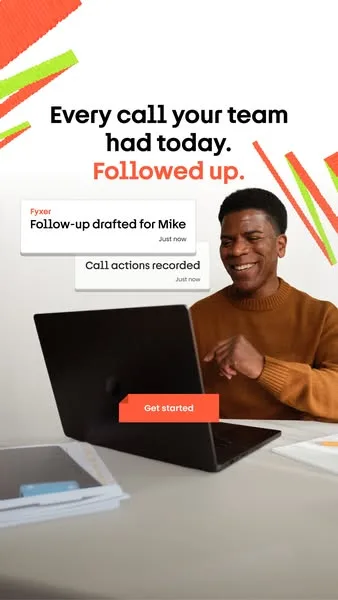
Fyxer static image ad: Everything looks equally important until it is too late. Fyxer learns your priorities and flags the thing that needs you today, so you act on the…

Static image · Captured 2026-10-22

“Everything looks equally important until it is too late. Fyxer learns your priorities and flags the thing that needs you today, so you act on the right one. Try Fyxer free. FYXER.COM Know what needs you now Sign Up”

The captured copy includes a free, trial or demonstration step. Study how that step connects the promise to an experience of the product. The captured next-step label is “Sign Up”.

Why this approach may work
A software promise becomes easier to assess when the ad names the job, shows the output and explains the next step.
What to question
Check eligibility, effort and what happens after the introductory step; the word free alone does not describe the commitment.
A variation to test
Compare a demonstration-led opening with a benefit-led opening while keeping the introductory offer fixed.
Evidence to use
The actual first-use experience and the terms of the introductory offer.
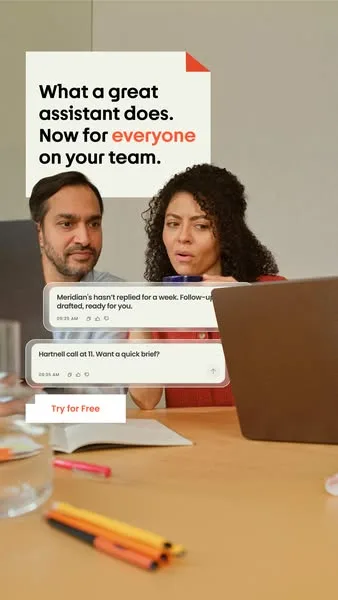
Fyxer static image ad: Plenty of tools can draft an email. Only one is built on real executive assistant expertise, so it knows what is important and catches what matters.…

Static image · Captured 2026-10-22

“Plenty of tools can draft an email. Only one is built on real executive assistant expertise, so it knows what is important and catches what matters. Try Fyxer free. FYXER.COM The AI Executive Assistant Sign Up”

The captured copy includes a free, trial or demonstration step. Study how that step connects the promise to an experience of the product. The captured next-step label is “Sign Up”.

Why this approach may work
A software promise becomes easier to assess when the ad names the job, shows the output and explains the next step.
What to question
Check eligibility, effort and what happens after the introductory step; the word free alone does not describe the commitment.
A variation to test
Compare a demonstration-led opening with a benefit-led opening while keeping the introductory offer fixed.
Evidence to use
The actual first-use experience and the terms of the introductory offer.
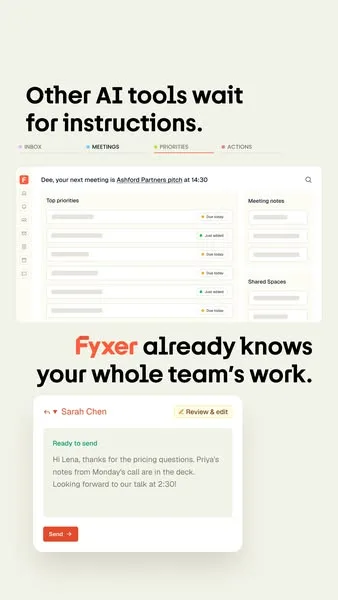
Fyxer static image ad: A promise made in a meeting should not vanish by Monday. Fyxer keeps what your team committed to easy to find again, across the tools you already…

Static image · Captured 2026-10-22

“A promise made in a meeting should not vanish by Monday. Fyxer keeps what your team committed to easy to find again, across the tools you already use. Try Fyxer free. FYXER.COM Shared clarity, less chasing Sign Up”

The captured copy includes a free, trial or demonstration step. Study how that step connects the promise to an experience of the product. The captured next-step label is “Sign Up”.

Why this approach may work
A specific situation helps the intended reader recognize relevance. The transition into the offer must explain why this solution fits that situation.
What to question
Check eligibility, effort and what happens after the introductory step; the word free alone does not describe the commitment.
A variation to test
Compare a demonstration-led opening with a benefit-led opening while keeping the introductory offer fixed.
Evidence to use
The actual first-use experience and the terms of the introductory offer.

Claims and offers are reproduced from captured ads. The breakdowns are creative hypotheses to evaluate with your own audience and results.

What shows up in this collection?

In this 24-artwork set, the most frequent specific angle labels are problem / frustration (6 creatives) and quality / accuracy (6 creatives). The selected examples come from Fyxer (2026-10-22), Fyxer (2026-10-22), Fyxer (2026-10-22). Compare the opening wording and evidence across those examples before choosing one variable to test.

Understand awareness stages
Suggested creative angles in 24 artworks
AngleArtworksShare
Problem / frustration625.0%
Quality / accuracy625.0%
Time savings520.8%

An artwork can have several suggested angles. These are frequencies in the captured archive, not measures of campaign performance.

How this collection was assembled

This page uses 24 distinct artwork hashes attributed to Fyxer in the October 22, 2026 archive snapshot. Counts use one canonical captured source per artwork. Angle labels can overlap. Format and awareness labels are research suggestions; they do not establish targeting or results.

How to turn this approach into a test.

  1. 1. Choose the audience situation

    Describe the reader's problem and current alternative. For this context, start with: people evaluating software for a recurring job. Write down what they already understand before choosing an awareness-stage opening.

  2. 2. Change one main creative variable

    Compare a demonstration-led opening with a benefit-led opening while keeping the introductory offer fixed. Keep the offer and landing page comparable so you can interpret the creative difference.

  3. 3. Gather proof before production

    Show a real workflow, including its input, output and setup requirements. Replace the reference's claims and branding with evidence and assets you can use for your own offer.

  4. 4. Define the result before launch

    A candidate measure here is cost per activated trial. Decide the conversion definition, attribution window and decision rule before comparing variants. Use the same reporting basis and record costs alongside response rates.

Turn the reference into your next test.

Adapt the opening, audience and evidence to your own product. Choose one variable to change and a measure that reflects your campaign objective.

Creative test details

Your test brief

Creative test brief

Reference: Fyxer — Fyxer ad examples

Audience: People evaluating software for a recurring job

Desired outcome: Complete a real workflow with less effort

Opening to test: Compare a demonstration-led opening with a benefit-led opening while keeping the introductory offer fixed.

Evidence to show: The actual first-use experience and the terms of the introductory offer.

Next action: Choose the next step that matches your offer

Primary measure: Cost per activated trial

Comparison: change the opening; keep the audience, offer and destination consistent.

Decide the budget, evaluation window and acceptable acquisition cost before the test.

Free tools for your next test.

All free tools

Plan the inputs, document the idea and calculate the result. No signup required.

Questions about these examples.

What can I learn from these Fyxer examples?

The examples make Fyxer's captured advertising easier to compare through captured copy, a source link and a hypothesis to test. A software promise becomes easier to assess when the ad names the job, shows the output and explains the next step.

How should I turn a reference into a test?

Compare a demonstration-led opening with a benefit-led opening while keeping the introductory offer fixed. Use your own artwork and substantiated claims. For this research context, cost per activated trial is a possible primary measure; choose the measure that matches your actual campaign objective.

Do these examples prove which ads performed best?

The archive records creative examples, not advertiser spend, conversions or return on ad spend. Frequency and repeated appearances do not establish performance. Evaluate your adapted idea with your own campaign results.