
Skip to content
IG Ad Library

Consumer apps, finance and education: comparison angles ads.

Study three comparison angles ad examples from consumer apps, finance and education. Compare their promises and evidence, then draft a focused creative test.

By IG Ad Library · Updated October 23, 2026

Selected from 107 distinct artworks across 7 advertisers. Archive snapshot: October 22, 2026.

How comparison angles advertising works

Compare products or approaches on criteria that matter to a specific buyer. A clear comparison reduces a complex choice to a small set of relevant differences, provided the alternatives are represented fairly.

Who the adaptation could serve
A planning audience for your adaptation: people comparing a service for a personal goal. Treat this as a brief-writing starting point; an ad's wording does not reveal the advertiser's actual targeting.
Evidence to prepare
A current, like-for-like comparison on a criterion the buyer can verify.
Three ads, broken down.

Compare products or approaches on criteria that matter to a specific buyer. These offers often ask for trust before a result can be experienced. Read the opening alongside eligibility, effort and terms; a simple first step should still explain what the customer is choosing.

Coursera static image ad: Interested in becoming a project manager? With the Google Project Management: Professional Certificate, you can build in-demand skills to start your…

Static image · Captured 2026-10-19

“Interested in becoming a project manager? With the Google Project Management: Professional Certificate, you can build in-demand skills to start your new career—now with AI training to help you stay ahead of the curve. In this beginner-fr”

A question appears in the captured copy. Examine the assumption it invites the reader to make and how the following claim answers it.

Why this approach may work
A clear comparison reduces a complex choice to a small set of relevant differences, provided the alternatives are represented fairly.
What to question
Are the compared versions, conditions and capabilities equivalent and current? Does the answer connect to the product's actual capability and the reader's situation?
A variation to test
Compare a fair side-by-side explanation with a single-product demonstration of the same advantage.
Evidence to use
A current, like-for-like comparison on a criterion the buyer can verify.
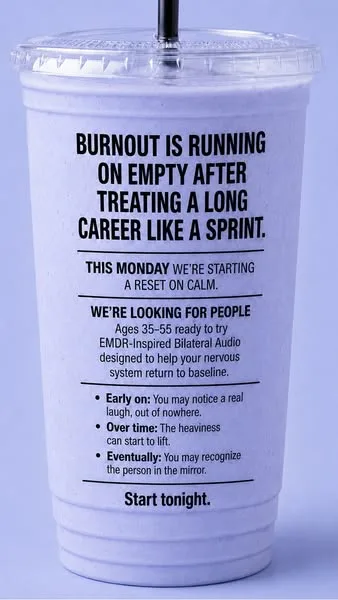
Calm static image ad: Stop what you’re doing ✋ How many minutes have you been mindlessly scrolling? Take a pause and switch the scroll for a 3-minute breathing session…

Static image · Captured 2026-10-18

“Stop what you’re doing ✋ How many minutes have you been mindlessly scrolling? Take a pause and switch the scroll for a 3-minute breathing session with Calm TRY DEEP REST TRY DEEP REST Learn More”

The copy refers to time or a recurring period. Identify the task, routine or delivery expectation attached to that language. The captured next-step label is “Learn More”.

Why this approach may work
A clear comparison reduces a complex choice to a small set of relevant differences, provided the alternatives are represented fairly.
What to question
Are the compared versions, conditions and capabilities equivalent and current? Distinguish a delivery promise, routine and measured time saving; they need different evidence.
A variation to test
Compare a fair side-by-side explanation with a single-product demonstration of the same advantage.
Evidence to use
A current, like-for-like comparison on a criterion the buyer can verify.
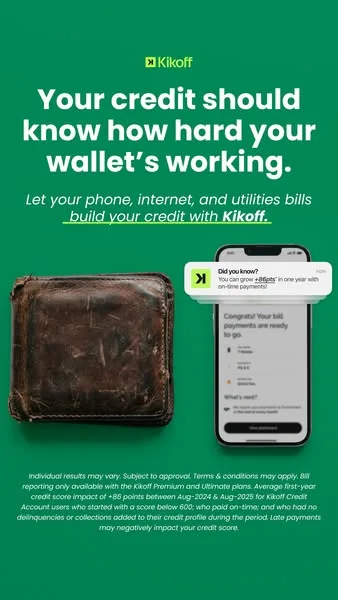
Kikoff static image ad: Let your bills build credit with Bill Reporting by Kikoff

Static image · Captured 2026-10-20

“Let your bills build credit with Bill Reporting by Kikoff Build Credit With Kikoff's Bill Reporting Build Your Credit with Kikoff: Top Credit Building App. Are you looking for ways to improve your credit? Whether you're new to building cr”

A question appears in the captured copy. Examine the assumption it invites the reader to make and how the following claim answers it.

Why this approach may work
A clear comparison reduces a complex choice to a small set of relevant differences, provided the alternatives are represented fairly.
What to question
Are the compared versions, conditions and capabilities equivalent and current? Does the answer connect to the product's actual capability and the reader's situation?
A variation to test
Compare a fair side-by-side explanation with a single-product demonstration of the same advantage.
Evidence to use
A current, like-for-like comparison on a criterion the buyer can verify.

Claims and offers are reproduced from captured ads. The breakdowns are creative hypotheses to evaluate with your own audience and results.

What shows up in this collection?

In this 107-artwork set, the most frequent specific angle labels are comparison (107 creatives) and education / mechanism (99 creatives). The selected examples come from Coursera (2026-10-19), Calm (2026-10-18), Kikoff (2026-10-20). Compare the opening wording and evidence across those examples before choosing one variable to test.

Understand awareness stages
Suggested creative angles in 107 artworks
AngleArtworksShare
Comparison107100.0%
Education / mechanism9992.5%
Time savings7671.0%
Problem / frustration6661.7%
Quality / accuracy3330.8%

An artwork can have several suggested angles. These are frequencies in the captured archive, not measures of campaign performance.

How this collection was assembled

This page uses 107 distinct artwork hashes across 7 advertisers in the October 22, 2026 archive snapshot. Counts use one canonical captured source per artwork. Angle labels can overlap. Format and awareness labels are research suggestions; they do not establish targeting or results.

How to turn this approach into a test.

  1. 1. Choose the audience situation

    Describe the reader's problem and current alternative. For this context, start with: people comparing a service for a personal goal. Write down what they already understand before choosing an awareness-stage opening.

  2. 2. Change one main creative variable

    Compare a fair side-by-side explanation with a single-product demonstration of the same advantage. Keep the offer and landing page comparable so you can interpret the creative difference.

  3. 3. Gather proof before production

    A current, like-for-like comparison on a criterion the buyer can verify. Replace the reference's claims and branding with evidence and assets you can use for your own offer.

  4. 4. Define the result before launch

    A candidate measure here is cost per qualified activation. Decide the conversion definition, attribution window and decision rule before comparing variants. Use the same reporting basis and record costs alongside response rates.

Turn the reference into your next test.

Adapt the opening, audience and evidence to your own product. Choose one variable to change and a measure that reflects your campaign objective.

Creative test details

Your test brief

Creative test brief

Reference: Coursera — Consumer apps, finance and education: comparison angles ads

Audience: People comparing a service for a personal goal

Desired outcome: Understand the service and complete a useful first action

Opening to test: Compare a fair side-by-side explanation with a single-product demonstration of the same advantage.

Evidence to show: A current, like-for-like comparison on a criterion the buyer can verify.

Next action: Choose the next step that matches your offer

Primary measure: Cost per qualified activation

Comparison: change the opening; keep the audience, offer and destination consistent.

Decide the budget, evaluation window and acceptable acquisition cost before the test.

Free tools for your next test.

All free tools

Plan the inputs, document the idea and calculate the result. No signup required.

Questions about these examples.

What can I learn from these examples?

The examples make comparison angles advertising in consumer apps, finance and education easier to compare through captured copy, a source link and a hypothesis to test. Are the compared versions, conditions and capabilities equivalent and current?

How should I turn a reference into a test?

Compare a fair side-by-side explanation with a single-product demonstration of the same advantage. Use your own artwork and substantiated claims. For this research context, cost per qualified activation is a possible primary measure; choose the measure that matches your actual campaign objective.

Do these examples prove which ads performed best?

The archive records creative examples, not advertiser spend, conversions or return on ad spend. Frequency and repeated appearances do not establish performance. Evaluate your adapted idea with your own campaign results.